Friday, February 02, 2007

Serious crunch


I've finally succumbed to the Fuschia Dunlop movement. After hearing uniform praise for her books, and upon the occasion of the publication of her latest (Revolutionary Chinese Cookbook, which treats Hunanese cooking), I finally bought both RCC and her first book, Land of Plenty (that takes on Sichuanese cooking).

(I apologize for the length of that last sentence. The offender will be dealt with.)

Always one to start at the beginning and work through to the end, I began reading Land of Plenty. As I read, I recognized one of the field marks of a new favorite cookbook: I found myself thinking, "That sounds good," or "That wouldn't be hard to make," as I paged through the recipes. The first one that got the nod was "Pork Slices with Black Cloud Ear Fungus." This is a stir-fry combining marinated pork, cloud ears, celery and chiles.

The marinade worried me, because the version that uses cornstarch calls for six teaspoons of cornstarch along with two tablespoons of water and a teaspoon of Shao Xing rice wine. (There's also a half teaspoon of salt involved.) This meant that the marinade was more viscous than liquid, but I dutifully lathered it over the pork slices as instructed. I didn't have Sichuan pickled chiles on hand, so I substituted some of the serrano chile pepper puree from Suzie Hot Sauce. I also substituted homemade turkey stock for the suggested chicken stock.

I needn't have worried, because the stir-fry cooked up just fine. The pork gets stir-fried first in a third of a cup of peanut oil, then the excess oil is poured off to leave about two or three tablespoons, the usual amount for a stir-fry. Then add chopped ginger, chopped garlic and the Sichuan pickled chiles (if you have them) and stir-fry briefly until they become aromatic. Now the sliced scallions, chopped cloud ears and sliced celery go in, also to be stir-fried briefly. The final step is the addition of the sauce which is based on a quarter of a cup of chicken stock, with a quarter of a teaspoon salt, an eighth of a teaspoon ground pepper and one and an eighth teaspoons of cornstarch (three-quarters of a teaspoon of potato flour, which Dunlop frequently uses in her recipes). Heat through and serve at once.

Cloud ears are essentially flavorless, but they have a very crunchy texture, and their black color can add a dramatic accent to a plate. When combined with the sliced celery, also a crunchy ingredient, it gives this stir-fry a very crunchy quality indeed. This contrasts with the moist morsels of pork. The savory sauce just ties the whole thing together. I was very impressed with the ease with which this dish cooked up, and I also enjoyed a new combination of ingredients for me. If this is any indication, I'm going to enjoy cooking from this cookbook quite a bit.

Tuesday, January 23, 2007

Only in Japan

Natto. Fermented soybeans. Very healthy, yet the sort of food that will make the unprepared run screaming into the hills. It's the slimy surface. Natto might be an acquired taste, but maybe it's more a food that you need to grow up with. It's the Japanese equivalent of lutefisk.

I had natto once, served with rice. The sliminess was difficult to deal with, of course, but apart from that, it wasn't bad. I keep telling myself I need to try natto again, but I haven't quite gotten around to it.

Natto has become the centerpiece of a great food scandal in Japan, because excessive health benefits were claimed for the slimy soybeans. Maki has a good post summing up the situation at i was just really very hungry.

Wednesday, January 17, 2007

Veggies


If you want to find out more about what happened to these vegetables (red bell pepper, celery and onion) after they got chopped up, go over to Paper Palate and read about skillet Creole chicken fricassee.

Monday, January 15, 2007

Suzie Hot Sauce


Perfect Tommy is one of those connoisseurs of substances measured in Scoville units. He likes hot stuff. In our meanderings along the Delaware River, we have frequently wandered by the little town of New Hope, Pennsylvania, home to all kinds of quaint boutiques. One of these stores is called Suzie Hot Sauce and it specializes in - you guessed it - hot sauce. Perfect Tommy has been pining for a chance to visit for ages, but whenever we've passed by, either the store hasn't been open or Perfect Tommy hasn't been in the mood.

Today's birding trip found us cruising by Suzie Hot Sauce a few minutes before 5 PM. Perfect Tommy was in the mood, there was a parking place, and in short order, we were in. The small store was absolutely stuffed with all manner of hot sauces and spicy condiments, several grades of hot pretzels for taste-testing purposes, chile-laced chocolate, Creole sauce mixes, you name it. There was a corner devoted to Asian hot sauces, but most of these were things I had seen in the Asian supermarket before. If you don't have an Asian market nearby, however, this could be a useful resource.

Since the store was closing at 5:00, there was no way we could scour the shelves with true discernment. We did our best, however. Perfect Tommy got some of the aforementioned chile-laced chocolate, some hot and spicy Cajun chips (which didn't last long), some hot pistachio brittle, some serrano chile puree and a small bottle of Cholula hot sauce. I was a little better and limited myself to the serrano chile puree, Tony Chachere's Creole seasoning (if only I'd had it last week) and some Outerbridge's Original pepper sherry. The woman behind the counter raved about the pepper sherry as I checked out; I told her I'd read about it and was curious to try it.

I also tried some of the hot pretzels. I worked my way up to the X hot level (the top is XX hot). I thought I handled it pretty well, but the burn turned out to be a slow-building one, and my stomach muttered at me for a while afterward.

As Perfect Tommy and I acted like, well, kids in a hot sauce store, The Lurker stood back and watched with his usual amusement. He is not a fan of spicy food, and so was immune to Suzie Hot Sauce's temptations.

All three of my purchases will doubtless liven up stir-fries and other dishes in the future. Better yet, I can now research hot sauces on the Hot Sauce Blog and have a hope of finding some of the obscure ones.

Wednesday, January 10, 2007

Roast chicken

Sunday night was an excuse for frivolity with The Cruise Director, The Fireman and family. The Deacon and The Frog Collector also stopped by. The Cruise Director put yours truly to work in the kitchen slicing onions, boiling green beans and offering advice on when to add ingredients to the saute pan. The main course was roast chicken with a nice peppery crust. Rather than a rack, the chicken was roasted on a bed of vegetables. This eliminated the problem of the chicken sticking to the bottom of the pan as well as providing a tasty side dish.

To say the chicken was moist is an understatement. When it came out of the oven, The Fireman held it over a bowl to allow it to drain for over a minute before putting it on the carving board. Once carving commenced, however, the cutting board quickly became awash in chicken juices. A turkey baster was pressed into emergency service for "reverse basting" and more chicken juices were added to the discard bowl. On the bright side, there is sure to be some excellent chicken stock in the offing. Besides, the chicken was tender and moist.

Wednesday, December 20, 2006

Whew

Any blogger with a Blogger account has been dealing with the Big Transition from old Blogger to Blogger Beta. As of today, Blogger Beta is "the new normal" and this blog finally got to switch over. I am overjoyed about the ability to tag posts, which means I'll be doing a lot of retroactive tagging to old posts (oh, goody, housekeeping). This will diminish the SevenSoy index a great deal, but I think the bibliographic posts will remain on the index. I also look forward to tweaking the template.

Tuesday, December 12, 2006

Cook's Illustrated does soy sauce


Disclaimer: none of the soy sauces in this photo were reviewed by Cook's Illustrated.

When I saw that the January/February 2007 issue of Cook's Illustrated had an article featuring soy sauces, I admit it, I got excited. Still, the first sentence of the piece indicated that I might not be the target audience for the article: "Most of us have rarely given soy sauce a second thought, using it as a kind of liquid salt." I suppose naming one's food blog after soy sauce doesn't qualify as rarely giving it a second thought (let alone keeping at least seven different varieties on hand).

Cook's taste-tested 12 soy sauces (or 11 soy sauces and La Choy's simulcrum of soy sauce based on hydrolized soy protein, if you prefer); two were Chinese soys while the others were Japanese-style soy sauces (four of them tamari). The sauces were tasted straight, served with warm rice, and used as an ingredient in teriyaki sauce.

Rather than easily crowning the single best soy sauce, the Cook's testers found that different soy sauces excelled at different applications. The ones with the most complicated and subtle flavor profiles did best when tasted straight and were recommended for use in dipping sauces. Simpler soys with stronger flavors held up better when cooked, however. Two soy sauces won the "Recommended" rating: Lee Kum Kee's mass-produced tabletop soy sauce and Ohsawa's traditionally-produced nama shoyu. Lee Kum Kee's sauce won the rice and teriyaki tests, while Ohsawa won the plain tasting.

Soy sauces tested, other than the ones previously mentioned, were:

Eden Organic Naturally Brewed Tamari Soy Sauce
Eden Organic Shoyu Soy Sauce
Eden Organic Traditionally Brewed Tamari Soy Sauce
Kikkoman All-Purpose Soy Sauce
Kikkoman Naturally Brewed Organic Soy Sauce
Kikkoman Naturally Brewed Tamari Soy Sauce
Pearl River Bridge Superior Light Soy Sauce
San-J Naturally Brewed Tamari Premium Soy Sauce
San-J Organic Shoyu Naturally Brewed Soy Sauce

The article is a pretty good introduction to soy sauce, especially for those who haven't given it much thought before. Those who've already started stocking a range of soy sauces so as to be appropriately equipped for whatever Asian cuisine they happen to be cooking on a given night may find it a bit elementary.

I have to admit that the heavy emphasis on Japanese soy sauces with a couple of Chinese soy sauces thrown in took me aback. It's not quite like comparing apples and oranges, but they aren't interchangeable, at least not when cooking Asian food. On the other hand, comparing an assortment of soy sauces ranging from Japanese shoyu to Chinese mushroom soy to Indonesian kecap manis really would be comparing apples to oranges to bananas. The best rule of thumb is still to use a soy sauce that hails from the same country as the dish you're cooking (or is at least made in the same style; it would be silly to disallow Kikkoman's soy sauces from Japanese cooking if they happen to come from Kikkoman's Wisconsin plant).

Monday, December 11, 2006

It's December

And what, pray tell, does that mean? Two things in food blogger-dom:

It's time for the Food Blog Awards, again. Nominations are open until midnight EST on Friday, December 15, so nominate your favorite food blogs for some recognition.

Then there's Menu For Hope III, a fundraiser that's fun, too. This year's beneficiary is the UN World Food Programme, so go have a look at the prizes and give as generously as you can.

Sunday, December 10, 2006

Chicken thigh donburi

Thanks to this post over at Nihon no Ryori, I realized that though I have loved chicken donburi for a long time, I've never made it with chicken thighs; I've always used breast meat. That seemed like a challenge, so the other night I gave it a go.

I used my usual method for making chicken donburi (or oyakodon), with the exception of using chicken thigh meat and turkey broth rather than dashi for the stock (no dashi in the house; I need to do something about that). When all was said and done, it was surprisingly different in flavor from my usual chicken donburi. Where the chicken breast version is sweet to the point of blandness (the flavor seems to concentrate itself in the broth-soaked rice), here the meat was as flavorful as the sauce. The strong flavor had a strong salty component, too, which I didn't expect. It wasn't bad, by any means, but it was so different from what I'm used to that I think I'll need to get used to it.

It was a worthy experiment, however. It's always good to see an old favorite dish through new eyes, and often hard to do because a cook (this cook, anyway) tends to get into a routine.

Thursday, December 07, 2006

Jeffersonian wine

Just a quick note, but I stumbled across this post on Vinography while scanning the RSS feeds. Thomas Jefferson as wine geek? What's not to love? (especially if you like history and fancy a glass of wine now and then, like me)

Monday, November 20, 2006

Return to Clinton Diner

I guess my announcement that I was back and blogging was a bit premature. I didn't want it to go this long without updates, but life can sometimes interfere with one's best-laid plans. But then, sometimes a really fabulous meal can interfere with life (or what passes for it), which is why I started this blog in the first place. Saturday night's meal was one of those occasions when I was imbued with a desire to blog the food as I experienced it.

I was gadding about with The Lurker and Perfect Tommy this weekend (as is often the case). Dinnertime found us heading back across the Delaware River into Jersey, a perfect time to think back on the Clinton Station Diner. Even though I had breakfast in what seemed to be the middle of the night the last time we visited this diner, I perused the menu enough to know that I wanted to order "real food" from this place someday.

Someday turned out to be last Saturday. As we pondered our choices, I decided to go for something on the light side; some fish and chips seemed to be the ticket. A little less expensive than the other entrees (like chicken marsala) that I wasn't in the mood for anyway. No biggie.

Well, when the platter arrived, I realized my "mistake." Slabs of fried fish were piled on top of a bed of mixed greens, side by side with the "chips" or fries, heftier and darker than regular french fries. An enormous expanse of food stretched before me. Well, diner portions do tend to be big...then there were the obligatory sides!

When I bit into the fried fish, I almost attained nirvana. The batter was crisp and light, and had a flavor that immediately brought tempura to mind. Within the crisp coating, the fish was perfectly done, slipping out into perfect slabs of fork-tenderness. (Golly, did I just write that? That's food porn!)

A lot of leftovers came home with me that night (not that I'm complaining), but that's the first time fish and chips has ever reminded me of tempura. I may need to up the ante next time I go back and order a longtime favorite like chicken marsala or prime rib. This diner is that good.

Friday, October 13, 2006

Back again


Well, I missed this blog's second birthday yesterday on the 12th, but I'm back now. Vacation was nice, but I'm looking forward to getting back in the swing of food blogging. Better yet, now I (finally) have a digital camera, so hopefully that will add something to the posts.

This image is of a mitsuba seedling. The garden didn't do all that well this year (on the other hand, The Deacon's garden didn't do well either, so I think it was a bad year for gardens in central Jersey), but the mitsuba continued to thrive. Great stuff.

Saturday, September 09, 2006

Temporary hiatus


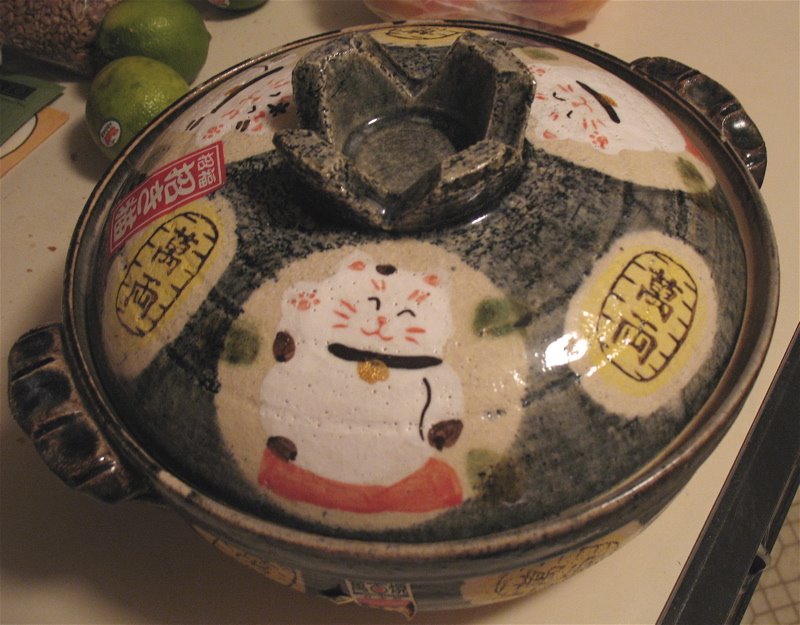
Well, lots of things are currently going on at Sevensoy Central. I'm starting a new job and also have some other projects that need to be dealt with. As a result, I'll be taking a bit of a vacation from Seven Kinds of Soy Sauce. Blogging will recommence in October. In the meantime, I'll leave you with a photo of my donabe, taken with my brand-new digital camera. Until then, happy cooking and eating!

Tuesday, September 05, 2006

Char siu


Char siu is Chinese marinated and roasted pork. It's traditionally considered to be something that you buy rather than making at home, because few people in China had ovens. When I'm in the corner of the Asian supermarket that is near the lunch counter, the tempting aroma of char siu is overwhelming.

Marnie Henricksson has a recipe she calls "Chinese Roast Pork Tenderloin" in Everyday Asian. The last time I read through the cookbook, it caught my eye.

The dish starts with a marinade. The ingredients are a third of a cup each of hoisin sauce, rice wine and soy sauce; a tablespoon of ketchup; two minced garlic cloves; and two tablespoons of light brown sugar (I used palm sugar). Henricksson recommends marinating the pork for one to three hours, but I let it go overnight.

In a 400 F oven, bake the tenderloin for 20 minutes, while boiling and slightly reducing the marinade on the stovetop. Remove the meat from the oven, baste, then return it to the oven for 10 to 20 minutes, depending on the thickness of the meat. Since I was using a relatively small hunk of boneless country ribs, I let it go for 10 minutes. The key is to let it go until it has a deep red color and some toasty browned bits. Simmer the remaining sauce for three minutes and let the meat rest for five minnutes before slicing.

Since my boneless country ribs were presliced, the meat dried out more than it would had the meat been in one unsliced chunk. That was a bit disappointing. However, the sauce was a terrific smoky barbecue type sauce, the kind of thing I'd happily slather on grilled meat (assuming I lived in a place where I was allowed to grill). The sauce was rather garlicky, too; the bits of minced garlic clung to the sides of the meat and imparted their toasted flavor to the dish. Not at all bad, but a little bit goes a long way. No wonder this meat is used to pep up flavors in Chinese cooking.

Sunday, August 27, 2006

Rice-stuffed game hen

I love cooking Cornish game hens but once I start eating them, I remember how much work it is to disassemble such a small bird. A couple of nights ago, I tried another game hen recipe, this one from the Frugal Gourmet's original cookbook.

Frug called this "Game Hens with Lebanese Dressing." The dressing is really stuffing; "dressing" makes me think of salads. The recipe is written for four game hens; I cooked one hen and halved the stuffing ingredient amounts. First off, you saute half an onion (sliced) in a tablespoon of butter until the onion is just starting to brown. I discovered that my butter was all played out, so I used olive oil instead. Once the onion has browned, add half a cup of rice, a cup of water, some pine nuts (1/16 of a cup, if you really want to halve the recipe precisely), quarter of a teaspoon each of allspice and cinnamon, and salt to taste. As this cooks down (I let it go until most of the water was absorbed), it looks dirty from the spices, but I suppose it really shouldn't be called "dirty rice."

Anyway, once the stuffing is done, pack it into the cavities of two game hens (if you have one, like I did, you can just use the rest of the stuffing on the side). Set the oven to 325 F and cook for an hour. Frug recommends serving the hens split in half, but I didn't do that.

The stuffing flavor was rather subtle, but nice. The spices and pine nuts added sweetness but not in an excessive way. The chicken juices made their way into the rice as well. Most of the skin was done to a paper-like brittleness that was very chewy; I probably should have brushed the skin with something (honey would've been good, and would've fit with the other ingredients) to keep it a little more moist.

All in all, it was a little something different in terms of roasting a bird, and very simple.

Saturday, August 26, 2006

Dithering quesadilla

I've been dithering about making quesadillas for a while. I pulled out How to Cook Everything and Moosewood Restaurant Cooks at Home and compared their quesadilla recipes. I dithered over the exact amounts of ingredients, the exact technique (use two tortillas or fold one over?). I thought about making them for breakfast, then was unable to motivate myself to get out of bed to chop the ingredients up.

The real problem was that I'd never made anything like quesadillas before, and I knew it was going to be a bloody mess in need of massive tinkering. Since I'm a perfectionist at heart, that was ample excuse to postpone quesadilla-making. Until today, that is. Today I made one for an afternoon snack.

I laid down one tortilla in an oiled skillet over medium heat. Then I added grated cheddar cheese, chopped onion, chopped button mushrooms and salsa. I topped the assemblage with another tortilla and toasted the quesadilla for two minutes. Then I flipped it and toasted it for three minutes. When it was done, I slid it onto a plate. I didn't follow Bittman's ingredients exactly, but I did follow his method of assembling the quesadilla.

Well, it was a revelation. Some of the filling squeezed out between the tortillas and the bottom one was a little soggy from the combination of the ingredients and the oil in the pan. I didn't care. It tasted terrific. When I finished it, I was sorry I hadn't made another, but of course I hadn't done that because, well, what if I didn't like it? It never fails.

I wouldn't call this authentic Mexican cuisine (not by a long shot) but I am glad I overcame my quesadilla dithering.

Thursday, August 24, 2006

Corn on the cob

It's that time of year again. When I drive around the area, I see cornfields full to bursting of tall cornstalks, their tassels waving in the wind. Although I live in a part of New Jersey that has more than its share of McMansions, townhouses and condo developments, some of the local farms are in farmland preservation programs. When one drives local roads, one has to be alert to the possibility of encountering a tractor tooling along the road like a tortoise. I'm sure others find that an inconvenience, but I don't. I think of it as something that adds value to the neighborhood.

There are farm stands scattered about of course, but in this area, even supermarkets sell corn and other produce from local farms. Yesterday I was at the supermarket and saw some corn from a farm in Monmouth Junction. After some hesitation (my corn-boiling pot is on the small side), I succumbed and got five ears.

Once upon a time, my dad told me the perfect length of time to boil corn. As I recall, this was in response to a Garrison Keillor monologue where Garrison divulged his perfect length of time to boil corn. My dad's response was, "Oh, no, absolutely not," or words to that effect. Maybe it was a cultural difference between Minnesota and Michigan (where my dad grew up). In any case, I wrote dad's recommendation on a piece of paper and promptly lost the paper. It's probably still here somewhere, stuck in a box full of other random pieces of paper.

So there I was last night, with two husked corn ears and a pot of boiling water, trying to remember the magic formula.

The ears themselves were a study in contrasts. They were a mix of white and yellow kernels. One was as regular as a city's grid street plan, while the other's rows wandered crazily across the ear. I'm tempted to say one ear was Midtown and the other was Downtown, in the oldest part of town, but comparing corn ears to the New York City street plan seems so wrong, in so many ways.

Parenthetical note: I really need to get a digital camera. That way this post would've been adorned with a photo of cornfields and another of the two husked ears in all their contrasting glory.

I thought the magic number was either seven or eleven minutes, but eleven seemed too long, so I plunked the corn into the pot and went for seven. I suppose I could ask my dad for the magic formula again, but that would be too easy. At the end of seven minutes, the corn came out of the pot, steaming hot. I applied the butter and waited for the corn to cool off a little. I've been trying to reduce my butter intake lately, but I splurged for this meal. I know there are lots of other good things you can put on corn, but corn on the cob with butter is the way I grew up doing it.

When I bit into the first ear, I knew I'd chosen correctly. It was perfect.

Saturday, August 19, 2006

The latest version of sesame noodles

I wrote about my fantasy of the perfect bowl of sesame noodles in this post some time ago. Last night I looked at the available ingredients in the cupboard and fridge, considered my lack of desire to cook, and decided to try Mark Bittman's "Cold Noodles with Sesame Sauce" from The Minimalist Cooks Dinner.

Bittman's sesame sauce consists of half a cup of sesame paste, a tablespoon of sugar, quarter of a cup of soy sauce, a tablespoon of rice vinegar and a tablespoon of sesame oil. Combine these ingredients; season with hot sauce, pepper and salt to taste; then pour over cooled, previously-cooked noodles. Garnish with sliced scallions.

Once I prepared this version of sesame noodles, I felt I was getting closer to the perfect fantasy, but the real sticking point that was bringing me crashing back to earth was the sesame paste. Even a smooth paste seems to have a bit of grittiness (if only a subliminal grittiness), and it really is astonishingly close to peanut butter. In addition to Lala's suggestion of using cashew butter instead of sesame paste, I may start trying sesame sauce mixes with a bit of sake or mirin to smooth things out and sweeten them up. Clearly the only thing that will do is for me to concoct my own version of sesame sauce.

On the other hand, the leftovers are on the docket for dinner tonight, and I expect they will be more than adequate for that purpose.

Sunday, August 13, 2006

Packing an Italian lunch

Sometimes (especially when I feel particularly cheap), I like to make my own lunch to bring along on birding trips. The best method of doing this is to cook dinner the night before and make sure plenty of leftovers are available. Not only does this mean there's one less thing to deal with in the morning when I'm trying to get myself on the road, it also means that if dinner disagrees with my stomach, I can put together Plan B for the trip. Intestinal issues are bad enough when you're at home; when you're on a birding trip and may be miles away from a pit stop, they can be catastrophic.

My birding pal The Lurker, like many, just packs a sandwich or two when he feels the need to brown-bag it. You might ask why I don't bring a sandwich. For some reason, I just don't make them for myself any more. I used to pack them frequently when I worked in New York City. Of course, these were the most boring sandwiches you could imagine: two slices of generic bread and some lunch meat completed the picture. Sandwiches just don't excite me, I guess. Besides, something like Thai fried rice seems to do a better job of keeping me going during the day.

Yesterday we went off to Delaware in search of shorebirds at Bombay Hook and the avian celebrity of the moment, a Scissor-tailed Flycatcher. I knew I wanted to pack a lunch, so I picked out a simple pasta recipe from Anne Casale's Italian Family Cooking, "Linguine with Shrimp." However, I didn't get to cook it until yesterday morning.

I didn't follow her ingredient proportions exactly because I was just cooking lunch and not wanting leftovers for a change. I sauteed three sliced scallions in a blend of a quarter-cup each of olive oil and butter for two minutes, then did the same with some garlic for a minute and a half. Then, in went the peeled shrimp, which I cooked over high heat until they turned pink. Then I turned the heat to low and added a few spritzes of lemon juice and a teaspoon of torn basil leaves; once this was heated through, I added half a teaspoon each of white pepper and salt, stirred a few times, then poured it over spinach fettuccini. By the end, the scallion bits were fairly brown and the sauce was rather oily, so I minimized the proportions of those ingredients when I dished it into my lunch container. I did add more sauce than I would normally, just to keep the pasta moist while it traveled around in the morning. The kitchen smelled wonderful, but it was time to run out the door.

Lunch found us at a Wendy's in Smyrna (along with everyone else in the county, it seemed). While my accomplices in crime waited on line to get their fast food, I started sampling my lunch. It was quite good; one unexpected thing I enjoyed was that the shrimp had cooked long enough to get a few little crispy brown bits on their edges. That made them extra tasty. When Perfect Tommy finally arrived at the table, carrying his Wendy's salad, he was able to guess the ingredients in short order. Later on, he suggested adding grated parmesan to top the dish, which sounds like a nice addition in the future. By the time The Lurker got to the table, my lunch was all gone, which meant that I wasn't the last one finishing my meal for a change.

Thursday, August 10, 2006

Raw cacao

Last week, my pal The Dancer stopped by to pick up some educational reading before her imminent trip to Iceland. Since I've always been a fan of Nordic climes, I've accumulated a pile of books on various Nordic topics. What I didn't expect was that she would present me with an envelope of raw cacao beans (shelled and flattened, apparently). I opened the envelope, sampled one and staggered back from the recoil of its flavor force.

Once I recovered, I stuck them in an empty jar that had once contained Paul Newman's salsa. A few days later, I opened it, took a whiff and staggered back from the aroma. This raw cacao is strong stuff.

When I told Perfect Tommy about what I'd scored, he told me I could make my own chocolate. I regarded this with suspicion since the idea of making sweets summons up images of molten sugar, hot pans and potentially nasty burns. Seeing my look of aversion, he followed up with the suggestion that I could just keep them in the jar and show them off to sundry guests as a curiosity. This sounds much safer, at least until I find some recipe that I'm willing to work with.